
Suchitra Sen, born Roma Dasgupta on 6 April 1931 and passing away on 17 January 2014, is widely known as the “Mahanayika” or Great Actress of Bengali cinema. She is remembered as one of the most iconic and respected actresses in the history of Indian films.
She became famous for her powerful performances in both Bengali and Hindi cinema. Her beauty, graceful screen presence, and emotional acting style made her a favorite among audiences. During the 1950s and 1960s, she was one of the biggest stars in Bengali films.

Suchitra Sen was known not only for her acting talent but also for her disciplined and private personality. In the later years of her life, she stayed out of public life and rarely appeared in the media. Because of this, she developed a mysterious and legendary image, similar to the reclusive style of some classic international film stars.
Her work and legacy continue to be respected, and she remains one of the most celebrated actresses in Indian cinema history.
Family Background
Suchitra Sen came from a traditional Bengali middle-class family whose roots were in what is now Bangladesh. Her upbringing, family values, and later her marriage into a wealthy Kolkata family all played an important role in shaping her personality and life choices.
Parents and early family life
She was born as Roma Dasgupta on 6 April 1931 in Bhanga Bari village in the Pabna district of Bengal Province, British India, which is now part of Sirajganj District in Bangladesh. Her father, Korunamoy Dasgupta, worked as a sanitary inspector in the Pabna Municipality and was known to be an educated and disciplined man. In some accounts, he is also described as working as a school headmaster later in life. Her mother, Indira Devi, was a homemaker who managed the household and raised the children in a conservative Bengali family environment.
Suchitra was the fifth child in the family and the second daughter. Growing up in a large household meant she spent her early years surrounded by several brothers and sisters in a traditional joint family atmosphere.
Her family also had a cultural and literary connection. On her maternal side, she was the granddaughter of Rajanikanta Sen, a well known Bengali devotional poet and composer. This connection to a respected literary figure is often mentioned as part of her cultural heritage.
Move to India and early marriage
The political and social upheaval surrounding the 1947 Partition led many families in the region to relocate. Around this period, Suchitra’s family moved from their ancestral home in Pabna to West Bengal in India, eventually settling in Kolkata.
In 1947, when she was around fifteen or sixteen years old, she married Dibanath Sen. He was the son of Adinath Sen, a wealthy businessman from Kolkata. The Sen family belonged to a respected business household and had social connections with influential circles in Bengal, including ties with the Tripura royal family.
Support from her husband’s family
At a time when acting was often considered unsuitable for women from traditional families, Suchitra Sen received support from both her husband and her father-in-law. They allowed and encouraged her to pursue a career in films, which was unusual for the social norms of that period.
Because her husband’s family was financially secure, she did not have to enter the film industry purely out of economic need. This stability gave her the confidence to build her acting career.
Husband and later family life
Her husband, Dibanath Sen, remained an important figure in her personal life. He died in 1970 in Baltimore in the United States, an event that deeply affected her. Many biographers believe his death contributed to her increasingly private and withdrawn life in later years.
Suchitra Sen and Dibanath Sen had one daughter, Moon Moon Sen, who later became an actress in Bengali and Hindi cinema and also served as a member of parliament.
Moon Moon Sen married Bharat Dev Varma, who belongs to the Tripura royal family. Their daughters, Raima Sen and Riya Sen, also became actresses, continuing the family’s connection with Indian cinema.
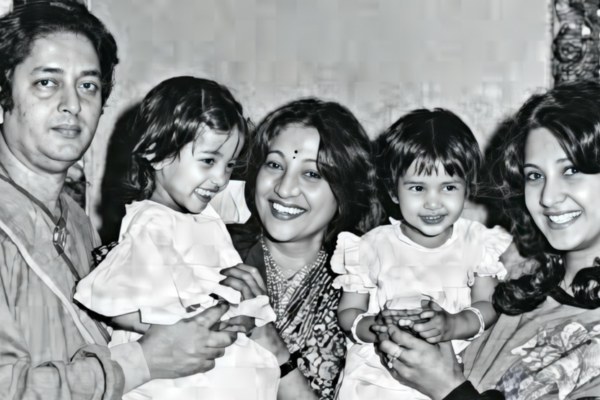
Overall, Suchitra Sen’s family background combined traditional Bengali cultural roots, a respected literary heritage, and later connections with influential business and royal families. This unique blend shaped the dignified, disciplined personality she carried throughout her life and career.
Career of Suchitra Sen
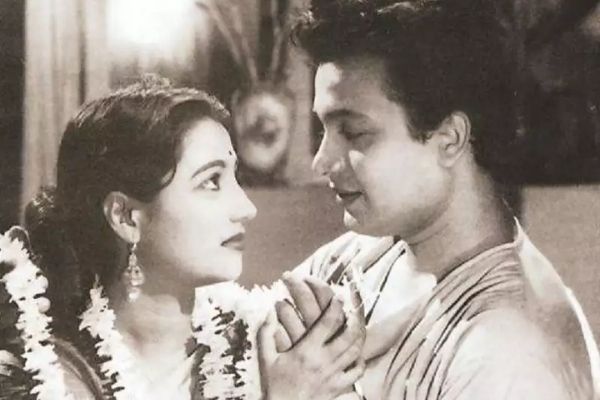
Suchitra Sen’s acting career lasted for nearly three decades and played a major role in shaping the image of the Bengali heroine. She was known for her graceful screen presence and strong emotional performances. Her career can be divided into several phases including her early breakthrough, her famous partnership with Uttam Kumar, her success in Hindi cinema, and her retirement from films.
Early Career and Debut
Suchitra Sen’s first film was Shesh Kothaay in 1952. However, the film was never released. Because of this, her official debut is considered to be the film Sharey Chuattor, released in 1953. In this film, she starred opposite Uttam Kumar. The movie became a huge success and started the legendary on-screen pairing of Uttam Kumar and Suchitra Sen.
In the same year she appeared in the film Bhagaban Shree Krishna Chaitanya, directed by Devaki Kumar Bose. She played the role of Vishnupriya in the film. Her performance gained wide appreciation and quickly established her as a rising star in Bengali cinema.
Golden Era with Uttam Kumar
During the 1950s, 1960s, and early 1970s, Suchitra Sen became one of the biggest stars of Bengali films. She acted in around sixty films during her career, and nearly thirty of them were with Uttam Kumar. Their romantic pairing became extremely popular and is still considered one of the greatest partnerships in Indian cinema.
Some of their most famous films include:
- Deep Jwele Jaai (1959), in which she played a nurse at a hospital and delivered one of her most powerful performances.
- Saptapadi (1961), in which she played Rina Brown. The film was a major success and earned her the BFJA Best Actress Award.
- Saat Pake Bandha (1963), which brought her international recognition. For this film, she won the Silver Prize for Best Actress at the Moscow International Film Festival, becoming the first Indian actress to receive such an honour.
- Uttar Phalguni (1963), in which she played a dual role of a courtesan and her daughter. The film won the National Film Award for Best Bengali Feature Film, and she again received the BFJA Best Actress Award.
She also acted in other successful Bengali films such as Grihadaha in 1967 and Alo Amar Alo in 1971. In many of her films, she portrayed educated, emotionally complex women who struggled between personal desire and social responsibility.
Success in Hindi Cinema

Suchitra Sen also achieved recognition in Hindi films. She made her Hindi film debut in Devdas in 1955, directed by Bimal Roy. In the film she played the role of Parvati, also known as Paro, opposite Dilip Kumar. The film was highly successful and introduced her to audiences across India.
Other important Hindi films in her career include:
- Bombai Ka Babu (1960) with Dev Anand
- Champakali (1967) with Bharat Bhushan
- Aandhi (1975) with Sanjeev Kumar
Her role in Aandhi was especially memorable. The political drama was believed to be inspired by Indira Gandhi’s life. Her performance received critical praise, and she was nominated for the Filmfare Best Actress Award.
Although she appeared in only a few Hindi films, titles such as Devdas, Mamta, and Aandhi made her widely known beyond Bengal.
Retirement and Final Film
After the death of her husband Dibanath Sen in 1970, Suchitra Sen gradually reduced her work in films. She continued acting for a few more years but became increasingly private.
Her final film was Pranay Pasha in 1978. The film did not perform well at the box office. Soon after its release, she decided to retire from acting.
Following her retirement, she completely withdrew from public life. She rarely appeared in public, avoided interviews, and even declined the prestigious Dadasaheb Phalke Award in 2005. Her decision to live a secluded life made her personality even more mysterious and legendary.
Awards and Achievements
Throughout her career, Suchitra Sen received many honours and awards for her performances.
Some of her major recognitions include:
- Several BFJA Best Actress Awards for films such as Saptapadi, Uttar Phalguni, Alo Amar Alo, and Priyo Bandhabi
- Silver Prize for Best Actress at the Moscow International Film Festival in 1963 for Saat Pake Bandha
- Padma Shri in 1972 for her contribution to Indian cinema
- Banga Bibhushan in 2012 for her contribution to Bengali culture and arts
Legacy in Indian Cinema
Suchitra Sen remains one of the most respected actresses in Indian film history. Her partnership with Uttam Kumar defined a major era of Bengali cinema and influenced generations of filmmakers and actors.
Her career followed a remarkable journey. She rose to fame in the 1950s, dominated the screen during the 1960s and 1970s, and then chose to step away from films while still admired by audiences.
Because of her unforgettable performances and her mysterious life after retirement, Suchitra Sen continues to be remembered as the eternal Mahanayika of Bengali cinema.
Controversies and Public Debate
Suchitra Sen’s life was not marked by the typical scandals of the film industry. Instead, most discussions about her revolve around her strict privacy, strong professional choices, and a few controversies connected to her films and career decisions.
The Aandhi Political Controversy
One of the biggest controversies linked to Suchitra Sen was the Hindi film Aandhi, released in 1975 and directed by Gulzar. In the film, she played Arti Devi, a powerful woman politician whose personal life struggles with the demands of public office.
Many people believed that the character was loosely inspired by the then Prime Minister of India, Indira Gandhi. Because of this similarity, the film became controversial during the Emergency period in 1975.
During that time, the film faced restrictions and was temporarily banned. Authorities were concerned that the story might influence public opinion about the ruling political leadership. Although the controversy was mainly political, it added to the strong, powerful image that Suchitra Sen projected on screen.
Refusal to Work with Raj Kapoor
Another widely discussed episode from her career involved actor and filmmaker Raj Kapoor. He reportedly offered her a role in one of his films.
However, Suchitra Sen declined the offer. She later mentioned that she did not like his personality and felt uncomfortable during their meeting. According to accounts, Raj Kapoor approached her with a bouquet while sitting close to her feet, a gesture she found inappropriate. Because of this, she refused to work with him.
This decision surprised many people in the film industry since Raj Kapoor was already a major star and filmmaker.
Turning Down a Film with Satyajit Ray
Suchitra Sen was also once considered for a film adaptation of Devi Chaudhurani, planned by director Satyajit Ray. Ray reportedly wanted her for the lead role but also expected her to work exclusively on the project for a certain period.
Suchitra Sen did not agree to these conditions because she already had other commitments. As a result, the project never moved forward.
Many film historians later described this as a missed opportunity because a collaboration between Suchitra Sen and Satyajit Ray could have been a major moment in Indian cinema.
Mystery Around Her Reclusive Life
After her husband’s death in 1970 and her retirement from films in 1978, Suchitra Sen gradually withdrew from public life. She rarely appeared in public and avoided media interviews.
This sudden disappearance from the public eye created many rumours. Some reports suggested that she had become deeply religious and spent time associated with the Ramakrishna Mission. Others speculated that she avoided public appearances because of health issues or a desire to protect her image.
None of these claims was officially confirmed. Her decision to remain private only increased the mystery around her life.
Professional Independence and Strong Personality
Suchitra Sen was known for maintaining strict control over her career and personal image. She carefully chose the roles she wanted to play and did not hesitate to decline major offers if she felt uncomfortable.
Some people admired her for this independence and dignity. Others in the film industry sometimes interpreted her behaviour as pride or stubbornness.
Because she protected her privacy so strongly, even her absence from public life became part of her legend.
Suchitra Sen and Uttam Kumar
The relationship between Suchitra Sen and Uttam Kumar is one of the most famous partnerships in Indian cinema. They were legendary co stars and close friends, and their on screen chemistry made them one of the most loved pairs in Bengali film history. However, in public they always described their bond as a professional and respectful friendship rather than a romantic relationship.
The Most Famous Pair in Bengali Cinema
Suchitra Sen and Uttam Kumar worked together in around thirty Bengali films between 1953 and 1975. Their pairing became extremely popular with audiences and helped define the golden age of Bengali cinema.
Some of their most well-known films together include Sharey Chuattor, Agnipariksha, Sagarika, Harano Sur, Saptapadi, Grihadaha, and Alo Amar Alo.
In many of these films, they played romantic partners or tragic lovers. Their emotional performances and natural chemistry made them known as the first great romantic couple of Bengali cinema. Their films often focused on love, sacrifice, social conflict, and family drama, which audiences connected with deeply.
Their Friendship Off Screen
Off screen, Suchitra Sen described her relationship with Uttam Kumar as a deep and sincere friendship. They respected each other greatly as actors and often supported one another during difficult times in their careers.
People from the film industry have said that their bond was affectionate but dignified. They shared a strong professional understanding and comfort while working together, which helped create their memorable on-screen performances.
There are also stories that Suchitra Sen sometimes advised Uttam Kumar in his personal life. In one well-known anecdote, she reportedly advised him to step away from a complicated extramarital relationship, showing how much he trusted her judgment.
Rumours and Public Speculation
Because of their powerful on-screen chemistry, many fans and gossip columns speculated that the two actors were romantically involved in real life. Some even claimed that their relationship caused problems in Uttam Kumar’s personal life.
However, there has never been any confirmed evidence of such an affair. Both actors were married and had families. Uttam Kumar was married to Gauri and later had a relationship with actress Supriya Devi. Suchitra Sen was married to Dibanath Sen.
Most biographers and industry insiders have described their bond as respectful and platonic.
A Unique Cultural Legacy
Many film historians describe the connection between Suchitra Sen and Uttam Kumar as something deeper than ordinary friendship but not romantic. It was a special artistic partnership built on mutual respect and shared success.
Their pairing became a cultural symbol of romance in Bengali cinema. Even decades later, they are remembered as the most iconic screen couple in Bengali film history.
Their story is often seen not as a tale of scandal or romance but as an example of how two great actors created magic together on screen while maintaining dignity and respect in their personal lives.
Uttam Kumar’s Death and Its Impact on Suchitra Sen
The sudden death of Uttam Kumar in 1980 was a major shock for Bengali cinema. For Suchitra Sen, it was also a deeply personal loss. Their long professional partnership and close friendship had connected them for many years, making his passing both an emotional and cultural moment.
Suchitra Sen’s Quiet Reaction
By the time Uttam Kumar passed away, Suchitra Sen had already withdrawn from public life. She had stopped appearing in films and had chosen to live in seclusion since around 1979. Because of this, she was rarely seen in public and avoided media attention.
After Uttam Kumar’s death, she did not give any public statements or interviews. She also did not appear at public mourning events or official ceremonies connected to his funeral. This silence surprised many fans who had admired their famous on-screen partnership.
However, her decision to remain silent was consistent with the private life she had chosen.
Personal Impact of the Loss
People in the film industry and later commentators have often suggested that Uttam Kumar’s death deeply affected Suchitra Sen. He had been her most frequent co-star and one of the closest colleagues in her career.
For decades, they had worked together and shared a strong artistic understanding. Their partnership had shaped an entire era of Bengali cinema.
Because of this history, many believe his death was a significant emotional loss for her, even though she never spoke about it publicly.
Continued Life in Seclusion
After Uttam Kumar’s death, Suchitra Sen continued to live quietly and privately for the rest of her life. She avoided public appearances and rarely allowed photographs or interviews.
Her life during these years was calm and deeply personal, focused on family and spiritual reflection.
For many observers, her silence after Uttam Kumar’s death and her long withdrawal from public life added to the mysterious and dignified image she maintained throughout her later years.
Last Years of Suchitra Sen
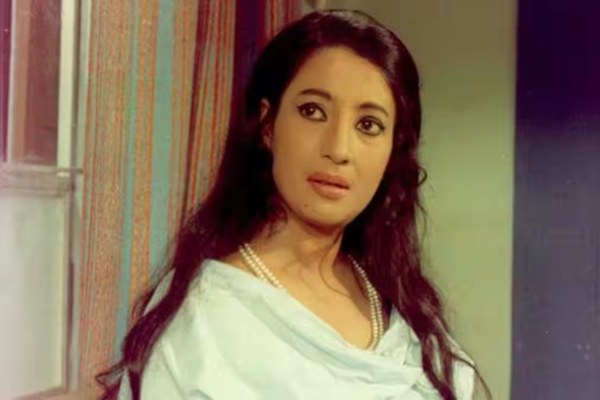
In the final decades of her life, Suchitra Sen lived in almost complete privacy. After retiring from films in 1978, she chose to stay away from public life and rarely appeared outside her home. She lived quietly in an apartment in South Kolkata and avoided media attention, interviews, and public events.
Her family, especially her daughter Moon Moon Sen, respected her wish for privacy. Because of this, very few photographs or public appearances of Suchitra Sen were seen after the 1990s.
During these years, she spent much of her time in prayer and spiritual reflection. Many accounts describe her as living a calm, simple life, focusing on religion and personal peace rather than on the glamour of the film industry she once dominated.
Illness and Hospitalisation
In late December 2013, Suchitra Sen’s health began to decline. She was admitted to Belle Vue Clinic, a well-known private hospital in Kolkata. Doctors reported that she was suffering from a serious lung infection and breathing problems, often linked to chronic respiratory illness.
She remained in the hospital for nearly three weeks. During this period, her condition improved at times but also worsened several times. Doctors had to provide oxygen support and other medical care to stabilise her health.
Some reports later mentioned that she refused certain medical procedures, preferring to maintain dignity rather than undergo prolonged or invasive treatment.
Death
Suchitra Sen passed away on 17 January 2014 at the age of 82. She died at the Belle Vue Clinic in Kolkata at around 8:25 in the morning.
Doctors stated that the immediate cause of death was cardiac arrest, which was related to complications from her lung infection and respiratory failure.
Her family tried to keep the situation private, but news of her death quickly spread across India and especially throughout West Bengal.
Public Reaction and Tributes
The news of her passing led to a wave of grief and tributes. Many actors, filmmakers, and political leaders remembered her as one of the greatest actresses in Indian cinema.
West Bengal Chief Minister Mamata Banerjee visited the hospital during her illness and later described her death as the end of an era in Bengali cinema.
Memorial gatherings were held across Kolkata. Tributes were organised at cultural venues such as Rabindra Sadan, and exhibitions celebrating her films and photographs were arranged at the Kolkata Book Fair.
Legacy
Suchitra Sen’s final years reflected the same dignity and mystery that defined her life. She chose to withdraw from public attention and live quietly, leaving behind an unforgettable legacy.
For many people in Bengal and across India, her death felt like the closing of a golden chapter in cinema history. Even today, she is remembered not only for her remarkable performances but also for the grace and privacy with which she lived her life.