
Meena Kumari was one of the most celebrated actresses in Indian cinema, remembered for her powerful performances and emotional depth. This biography explores the story of her life, including her childhood, family background, rise in films, marriage, personal struggles, and her tragic death at the age of thirty nine.
Born into a family connected to the entertainment industry, Meena Kumari entered films at a very young age. Her family encouraged her work in cinema, and she quickly became a well known face in the industry. Over time she built a remarkable career and earned a reputation for portraying deeply emotional characters with great realism.

She later became widely known as the tragedy queen of Bollywood. Although the title followed her throughout her career, it was not something she personally embraced. The label came from her unforgettable performances in films that focused on sorrow, sacrifice, and emotional conflict. Movies such as Pakeezah, Mere Apne, and Saheb Biwi Aur Ghulam remain some of her most celebrated works.
Despite her professional success, Meena Kumari’s personal life was filled with difficulties. Her marriage faced serious problems, and her relationships often ended in disappointment. As these struggles continued, she turned to alcohol, which gradually affected her health.
Her life reflected a striking contrast between fame and personal pain, making her one of the most memorable and tragic figures in the history of Bollywood.
Meena Kumari’s life had no glamour if you look closely, and she died at a very young age. the Hindi song ‘Har Kisi Ko Nahin Milta Yahan Pyar Zindagi Mein’ perfectly fits Meena Kumari’s life.
Like many of her contemporaries, Meena Kumari was born into a Muslim family and began her career as a child artist (Nargis, Madhubala, etc. also started their careers as child artists).
Children Family Biography
| Name | Mahjabeen Bano |
| Date of Birth | 01 Aug 1933 |
| Place of birth | Mumbai, Maharashtra, India |
| Father | Master Ali Bux |
| Mother | Iqbal Begum |
| Stage Name | Meena Kumari |
| Other names | Reading Mahjabeen, Tragedy Queen, Manju |
| Debut movie | Leatherface |
| Marital status | Married |
| Husband Name | Kamal Amrohi |
| Children | NO children ( daughter or son) |
| Died on | 31st March 1972 |
| Death reason | Prolonged health issues due to drinking |
| Age at the time of death | 38 Years |
| Last movie | Gomti Ke Kinare |
Meena Kumari Early Life
When was Meena Kumari born

Meena Kumari was born on 1 August 1933 in a modest chawl called Meetawala Chawl in Dadar, Bombay, now Mumbai. Her birth name was Mahjabeen Bano. Her father Ali Bux and mother Iqbal Begum welcomed her at Dr Gadre hospital in Parel, where Iqbal Begum stayed for about seven days after delivery before returning home with the child.
Mahjabeen grew up with two sisters. Her elder sister was Khurshid and her younger sister was Madhu. The family lived a simple life and struggled financially during those early years.

Her father Ali Bux was originally from Bhera village in the Sargodha district of Punjab, which is now in Pakistan. He had a deep interest in music from a young age and became skilled at playing the harmonium, which was a very important instrument in traditional music at the time. Because of his talent, people in his village began calling him Master, a title that stayed with him throughout his life.
Ali Bux first married a woman from a nearby village and became the father of three daughters. However, he felt that his village offered very few opportunities for growth. Hoping to build a better future, he decided to move to Bombay to pursue work in the music industry, leaving his family behind for some time.
In Bombay, he worked as a harmonium player for the Krishna Music Company. During this period he met a dancer named Prabhabati, who was a Bengali Christian and had family roots connected to Rabindranath Tagore. The two later married, and Prabhabati converted to Islam, taking the name Iqbal Begum.
In 1935 the family temporarily moved to Lahore for about a year because Ali Bux suffered from an illness that doctors struggled to diagnose. They advised him to rest for some time. After the family returned to Bombay, another hardship followed when Iqbal Begum developed a lung infection. This forced her to stop working as a dancer and actress.

Financial problems continued for the family. Mahjabeen’s elder sister worked as a child artist in films, but her earnings were not enough to support the household. Seeing the need for additional income, Ali Bux decided to introduce Mahjabeen to the film industry as well.
His efforts paid off when filmmaker Vijay Bhatt gave the young girl a small role in one of his films. From that moment her journey in cinema began. Vijay Bhatt also gave her the screen name Baby Meena, which later evolved into the name Meena Kumari.
During her childhood Meena suffered an injury that damaged the pinky finger of her left hand. Despite this, she managed to hide the injury gracefully in her films. Even with such challenges, her early entry into cinema marked the beginning of a remarkable career that would later make her one of the most memorable actresses in Indian film history.
Meena Kumari Career and films
It was 1946 and baby Meena is now considerably grown up for a child artist. She got her kind of first adult role in Bachchon Ka Khel.
Slowly and steadily she was establishing herself in Hindi Cinema but in the meantime, in 1947 she lost her mother. They have moved to their new house at Chapel Road, Bandra from the Chawl in Dadar.
By the end of 1950, Meena Kumari had signed Kamal Amrohi’s picture Anarkali. Initially, Kamal had chosen Madhubala for this role, but later Madhubala refused to work in this film.

It is said that she wanted Dilip Kumar as the hero of this film, but it could not happen, so she refused to work with it. And some reports also say that the relationship between Kamal Amrohi and Madhubala’s father was not that good, so she refused to do this film.
Although Nargis was a big star during the 1950s, she mostly worked in RK films. Madhubala refused to do this picture and Suraiya stopped taking more work after a breakup with Dev Anand. So Meena Kumari was the best option left for the makers.
But in May 1951 Meena Kumari met with an accident that left her bedridden for four months and this was the period she developed an affair with Kamal Amrohi.
The movie Anarkali could not be completed as its producer lost a heavy chunk of his money in the Share market. But Meena Kumari signed two other movies in the meantime, Footpath and Baiju Bawra.
She won the “Best Actress” award in the first Filmfare Awards in 1954 for her role in “Baiju Bawara”. Also, music director Naushad won the “Best Music” award for the movie.
The film ‘Baiju Bawra’ is one of the classic musical blockbuster movies. The film is set during Akbar’s reign and is based on the life of renowned musician Baiju Bawra. The film depicts Baiju Bawra’s desire to avenge his father’s death at the hands of the music emperor Tansen, who was one of Akbar’s nine gems. However, there are numerous differences between the film’s plot and the popular legends of Baiju Bawra.
The success of Baiju Bawara established her as a star to reckon with. Meena Kumari appeared in seventy-seven movies in her career that was spanned more than three decades.
In 1962 one of her best movies was released (Saheb Biwi Aur Gulam) and also see it was the peak time in her career.
In the 1963 Filmfare awards she made history with all performances nominated for Best actress belonged to her. Saheb Biwi Aur Ghulam with Guru Dutt, Mein Chup Rahungi with Sunil Dutt, and Aarti with Ashok Kumar.
In 1972 Pakeezah became the last movie that was released when she was alive, though battling with life. Initially, the film did not do anything special, but when the news of Meena Kumari’s death spread across the country, people thronged the film hall and Pakeezah proved to be a super hit film.
After her death, only one film was released which was Gomti Ke Kinare and this was credited as her last movie to be released.
Her Love affair and marriage
On 21st May 1951, Meena Kumari met with a road accident when returning from Mahabaleswar in which she suffered many injuries, and she was lying in the hospital for 4 months. Kamal Amrohi used to visit Meena Kumari during this time in Poona’s hospital.
It is said that this was the time when both came closer to each other, and love started between the two. However, Kamal Amrohi was married at that time and had three sons. But all this could not become a wall between the love of Meena Kumari and Kamal Amrohi, and both of them came closer to each other.
Meena Kumari used to call Kamal Amrohi “Chandan” and Amrohi used to call her “Manju” with love.
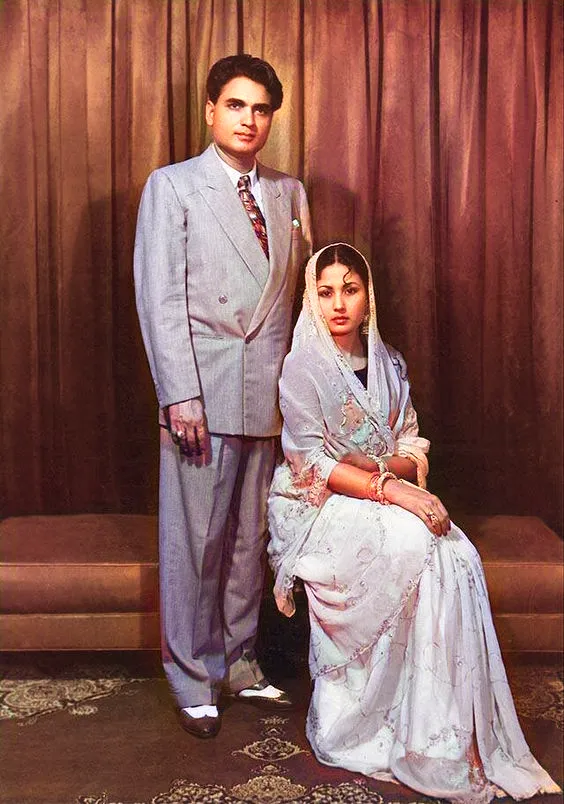
When Meena Kumari was discharged from the hospital, both kept talking on the phone till late at night. The love between the two grew, and in 1952, both of them quietly got married. Both wanted to keep this thing hidden from the world. This was known to one of Kamal Amrohi’s friends, the Kazi who got them married, and Meena Kumari’s younger sister Madhu.
Meena Kumari wanted to keep her marriage hidden from her father, but her father came to know. And there was a lot of fight between them regarding the marriage, and her father had even told Meena Kumari to immediately divorce Kamal Amrohi. But Meena Kumari was not ready for this.
Although father and daughter used to fight a lot about this matter, Meena Kumari did not leave her father’s house. In 1953, Kamal Amrohi made a film in which he asked Meena Kumari for the lead role, and Meena Kumari also said yes to the offer.
But this was not acceptable to her father. So he tried to pressure Meena Kumari and asked her not to work in Amrohi’s film. But she did not listen to him and reached the shooting of Amrohi’s film. When her father came to know about this, then one day (on 14th August 1953), when Meena Kumari returned from shooting, her father refused to open the door of the house. So on that day, Meena Kumari left her house and went to Kamal Amrohi’s house.
Kamal Amrohi and Meena Kumari even made a movie called Daaera in 1953 which was based on their love story but the movie did not do that well at the box office.
The initial years were fine, and the couple was happy. Gradually, the sourness in the relationship between both of them increased, and the distance also increased. And by 1964, the distance increased so much that Meena Kumari left her husband’s house.
She spent a few days at her friend’s house and then she moved to the house of famous comedian Mehmood, who was her younger sister’s husband. She spent about 5 months at Mehmood’s house, and after that, she shifted to her new house.
During this Meena Kumari had started drinking alcohol or rather she was now addicted to alcohol. Though Meena Kumari stayed with her husband for 11 long years they had no children.
Dharmendra and Meena Kumari
Dharmendra was a newcomer to Hindi cinema then and Meena Kumari was an established star then. The first movie of both was Poornima which was released in 1965. But this film did not do that well at the box office. The second film was Kajal but Dharmendra was the second lead in this film while Rajkumar was the first lead.
Both appeared in more than 5 movies. At that time, many print media published the news that Dharmendra and Meena Kumari had a love relationship. Vinod Mehta, who wrote the biography of Meena Kumari, has also written in his book that there was a relationship of love between the two. However, Dharmendra has denied this in many of his interviews and said that Meena Kumari was like his mentor and was also a big reason for his success in his career.
Meena Kumari death
Meena Kumari had a sleep disorder that is insomnia, due to which the doctor advised her to sleep after drinking a peg of brandy.
But this one peg brandy turned into a bottle. Slowly Meena Kumari became addicted to alcohol and after she left her husband’s house, her acquaintances say that she had started drinking even during the day. Because of this, her liver started getting affected and she started getting sick often.
In 1968, when she fell very ill, after the doctor’s advice, her close friend took her to London for better treatment. There she got her treatment and stayed there for a few months. And when her health got better, she came back to India.

She completed some of her assignments and took some new assignments, including Mere Apne, Gomti Ke Kinare,and Pakeezah.
Pakeezah was something her husband Kamal Amrohi and she planned long ago when they were together. Finally, they started Pakeezah after she returned from London and completed it.
In an interview, Gomti Ke Kinare director and writer Saawan Kumar Tak said that he used to be with her in Meen Kumari’s last days and saw her in pain. He even claimed that the duo had a spiritual relationship. He even said that she helped him financially with the movie. She sold her bungalow to actress Mumtaz and gave him 150000 Rupees.
The movie was released in February 1972 and was not a hit among the masses. Due to her prolonged liver disease, which got serious, Meena Kumari was admitted to St Elizabeth’s Nursing Home in Malabar Hill on 27th March 1972.
At the last moment, when the doctor advised Meena Kumari to shift to the hospital, Meena Kumari wondered how she would pay such a huge hospital bill because she had only Rs 100 left at that time. Then she asked her elder sister Khurshid to call her producer with whom Meena Kumari had worked and some money was owed to her.
Her elder sister immediately called up the producer and the producer too, showing sincerity, immediately sent the money to Meena Kumari’s house.
On 31st March, she died, and as soon as the news reached her fans, the emotion brought them to the cinema hall. The usually empty shows were jam-packed. Theatres even saw advance booking.
It took her life to make Pakeezah one of the cult movies of Indian cinema. With Meena Kumari death there was the end of an era.
It is reported that when Nargis Dutt last visited Meena Kumari when she was in the hospital, Nargis said ‘Maut Mubarak Ho Meena’.
Meena Kumari Books
If you are fascinated by Meena Kumari’s life and want to know every small detail of her life then you can refer to these books.
Pakeezah Story
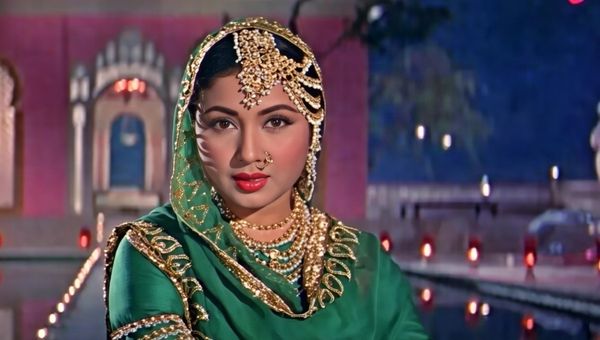
Pakeezah (1972), directed by Kamal Amrohi, is one of the most famous films in Bollywood history, not only for its story and music but also for its unusually long production. The film took about sixteen years to complete, beginning in 1956 and finally releasing in 1972. The long delay was caused by several factors, including Amrohi’s perfectionism, Meena Kumari’s busy acting schedule, and the eventual breakdown of their marriage.
Development and pre production
The idea for Pakeezah began in 1956 when Kamal Amrohi conceived the story during a trip to Mahabaleshwar with his wife Meena Kumari. He wrote the screenplay with the intention of presenting her in the role of a tragic courtesan named Sahibjaan. Early advertisements for the film began appearing in magazines around 1958, though the title changed several times during development.
Amrohi paid close attention to visual detail while designing the film. Many of the set designs were inspired by his ancestral haveli in Amroha.
One of the most elaborate sets was the Bazaar e Husn, used for the song “Inhi Logon Ne.” This set alone reportedly cost more than one million rupees and took several months to construct. Hundreds of workers helped build the environment using materials such as cloth, plywood, and muslin. The set was decorated with luxurious elements like Belgian chandeliers to create the atmosphere of a royal courtesan house.
Filming challenges
Principal photography for Pakeezah began on 16 July 1956 with German cinematographer Josef Wirsching. The film was originally planned in black and white, but Meena Kumari suggested that it should be shot in color to enhance the visual appeal. As a result, the production later switched to Eastmancolor. The crew also experimented with CinemaScope lenses rented from MGM, although they faced technical difficulties with focus and lighting.
Production faced many interruptions over the years. Meena Kumari was one of the busiest actresses of the 1950s and 1960s, which meant she could only dedicate limited time to the project each month. In addition, her marriage with Kamal Amrohi deteriorated, and their separation in 1964 caused the project to stall for several years.
Tragedy also affected the film’s production team. Cinematographer Josef Wirsching and music composer Ghulam Mohammed both passed away before the film was completed. Despite these setbacks, Amrohi eventually resumed filming around 1970 with a partially new crew.
By this time Meena Kumari’s health had declined significantly. Because of her illness, some close up shots and dance sequences had to be filmed while she remained seated. Additional outdoor scenes were filmed in cities such as Delhi, Lucknow, and Varanasi. The production finally wrapped in November 1971. During editing, the original footage of about thirty five thousand feet was reduced to roughly fourteen thousand feet for the final release.
Music and release
The music of Pakeezah became one of the film’s most celebrated elements. Composer Ghulam Mohammed had created the soundtrack before his death, with lyrics written by poets such as Kaifi Azmi and Majrooh Sultanpuri. Songs like “Inhi Logon Ne,” “Chalo Diye Jalao,” and “Teer e Nazar” later became iconic in Indian film music.
The film was released on 4 February 1972. It received widespread acclaim for its rich visual style, emotional storytelling, and memorable music. Meena Kumari’s performance as Sahibjaan was especially praised and became one of the defining roles of her career.
Despite the difficult and lengthy production process, Pakeezah eventually achieved classic status in Indian cinema. The film’s tragic beauty, combined with the real life struggles behind its creation, has made it one of the most enduring works associated with Meena Kumari and Kamal Amrohi.
Meena Kumari Movies/ filmography
| Year | Movie Title | Character Played | Director | Producer | Lead Opposite Actor |
|---|---|---|---|---|---|
| 1939 | Leatherface | Child Role (Baby Mahjabeen) | Vijay Bhatt | Prakash Pictures | Jairaj |
| 1946 | Bachchon Ka Khel | Gauri | Raja Nene | Ramnik Productions | Agha |
| 1952 | Baiju Bawra | Gauri | Vijay Bhatt | Prakash Pictures | Bharat Bhushan |
| 1953 | Parineeta | Lalita | Bimal Roy | Ashok Kumar | Ashok Kumar |
| 1953 | Daera | Sheetal | Kamal Amrohi | Kamal Pictures | Nasir Khan |
| 1953 | Do Bigha Zamin | Thakurain | Bimal Roy | Bimal Roy Productions | Balraj Sahni |
| 1956 | Ek Hi Raasta | Malti | B.R. Chopra | B.R. Chopra | Ashok Kumar |
| 1957 | Miss Mary | Miss Mary | L.V. Prasad | A.V.M. Productions | Gemini Ganesan |
| 1957 | Sharada | Sharada | L.V. Prasad | A.V.M. Productions | Raj Kapoor |
| 1960 | Dil Apna Aur Preet Parai | Karuna | Kishore Sahu | Kishore Sahu | Raaj Kumar |
| 1960 | Kohinoor | Rajkumari | S.U. Sunny | V.Shantaram | Dilip Kumar |
| 1962 | Sahib Bibi Aur Ghulam | Chhoti Bahu | Abrar Alvi | Guru Dutt | Guru Dutt |
| 1962 | Aarti | Aarti Gupta | Satyen Bose | Tarachand Barjatya | Ashok Kumar |
| 1962 | Main Chup Rahungi | Gayetri | A. Bhimsingh | A.V.M. Productions | Sunil Dutt |
| 1963 | Dil Ek Mandir | Sita | C.V. Sridhar | Rajkamal Kalamandir | Rajendra Kumar |
| 1965 | Kaajal | Kaajal | Ram Maheshwari | Pannalal Maheshwari | Dharmendra |
| 1966 | Phool Aur Patthar | Shanti | O.P. Ralhan | O.P. Ralhan | Dharmendra |
| 1971 | Mere Apne | Anandi Devi | Gulzar | N.C. Sippy | Vinod Khanna |
| 1972 | Pakeezah | Nargis / Sahibjaan | Kamal Amrohi | Kamal Amrohi | Raaj Kumar |
| 1972 | Gomti Ke Kinare | Ganga | Saawan Kumar Tak | Saawan Kumar Tak | Sameer |
FAQs
At what age Meena Kumari died?
Meena Kumari died at the age of 38 years and 7 months of age.
Who is Meena Kumari daughter?
Meena Kumari did not have any children. Her husband had a daughter from his first marriage.
What was Meena Kumari last movie?
Gomti Ke Kinare was the last movie of Meena Kumari.
Where is Meena Kumari buried?
She is buried near her father and mother grave at Rehmatabad Graveyard in Mumbai.
Who is Meena Kumari husband?
Kamal Amrohi was the husband of Meena ji. Both got married in 1952 secretly.
Biopic
The much-anticipated Meena Kumari Biography film, tentatively titled Kamal Aur Meena, is gaining momentum with exciting updates. Acclaimed director Siddharth P. Malhotra, celebrated for hits like Hichki and Maharaja, has stepped in to lead the project after fashion mogul Manish Malhotra relinquished his directorial role in November 2024. Initially, Manish Malhotra had envisioned this as his filmmaking debut, with Kriti Sanon set to portray the legendary actress, but he recently announced his departure, citing a pivot to other creative ventures.
Under Siddharth P. Malhotra’s vision, this Meena Kumari Biography will delve into the stormy romance between the iconic actress and her filmmaker husband, Kamal Amrohi. Departing from a typical art-house narrative, the movie promises a vibrant, commercial drama, enriched by over 500 personal letters and journals exchanged between the couple. Pre-production is in full swing, with screenwriter Kausar Munir finalizing the script and dialogues by late February 2025. Filming is slated to kick off later in 2025, targeting a grand 2026 release.
Casting for this Meena Kumari Biography remains a hot topic. While Kriti Sanon was linked to the role during Manish Malhotra’s tenure, the project’s new direction has sparked fresh speculation. Vidya Balan emerges as a top candidate to embody Meena Kumari, though some question her suitability for depicting the star’s youthful years (ages 18–24) in the film’s early segments. Meanwhile, names like Kiara Advani and Shraddha Kapoor are also in the mix, with online fans vocally championing Shraddha Kapoor for her potential to capture Meena Kumari’s essence. An official casting reveal is still pending.
The Meena Kumari Biography enjoys robust support from the Amrohi family, with Kamal Amrohi’s grandson, Bilal Amrohi, co-producing alongside Saregama and Lionheart Cinema. This backing marks a shift from earlier friction, as Meena Kumari’s stepson, Tajdar Amrohi, had previously opposed Manish Malhotra’s version, even threatening legal action over unauthorized storytelling. With family approval secured, the project is poised to proceed smoothly.
This Meena Kumari Biography aims to illuminate not only her cinematic brilliance but also the emotional highs and lows of her life with Kamal Amrohi, culminating in the creation of her timeless masterpiece, Pakeezah. As production advances, expect more revelations about casting and progress in the months ahead, making this a must-watch for fans eager to revisit the legacy of Bollywood’s Tragedy Queen.