
Rohit Sharna is one of the most talented cricketers of all time. He has won two ICC cricket cups under his captaincy: the ICC T20 World Cup as Rahul Dravid‘s coach and the Champions Trophy as Gautam Gambhir’s coach.
Rohit Sharma was born into a Marathi family in Bansod, Nagpur, but his formative years were spent in Borivali, Mumbai, under the care of his grandparents and uncles. His father, Gurunath Sharma, worked as a caretaker for a transport company, while his mother, Purnima Sharma, was a homemaker. Financial constraints meant Rohit’s early life was challenging, but cricket became his refuge.
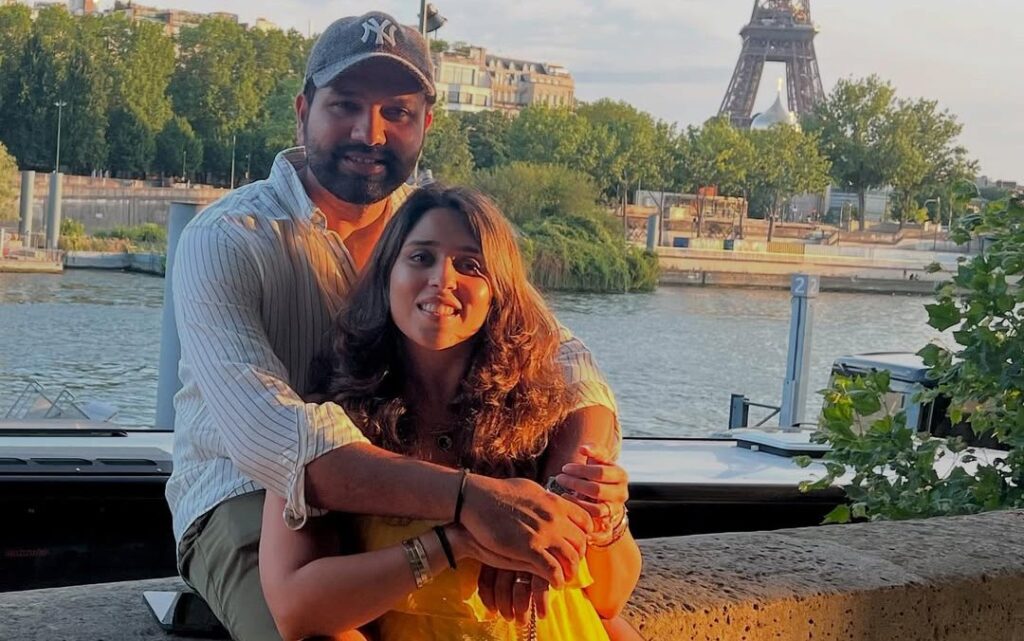
From a young age, Rohit Sharma showed a natural flair for the game, often playing with friends using makeshift equipment in the neighbourhood. His talent was spotted in 1999 during a cricket camp, where coach Dinesh Lad recognized his potential. “I saw Rohit when he was 12 years old,” Lad recalled in an interview with NDTV Sports. “He was batting in the nets, and I was amazed by his talent. I knew he had something special.” Lad encouraged Rohit to transfer to Swami Vivekanand International School, which had better cricket facilities, and Rohit received a scholarship, easing the financial burden on his family.
Rohit’s early influences included watching cricket legends like Sachin Tendulkar and Virender Sehwag. He idolized Tendulkar and often tried to emulate his batting style, which laid the foundation for his elegant stroke play.
Personal Life
Rohit Sharma was born on April 30, 1987, in Nagpur, Maharashtra. He grew up in a modest household where financial resources were limited. His early life was shaped by these challenges, which influenced many of the decisions made by his family while supporting his education and cricket development.
His father, Gurunath Sharma, worked as a caretaker in the warehouse of a transport company. The income from this job was modest, and the family lived in a small single room house in Dombivli, a suburb of Mumbai. Managing household expenses was often difficult, and the family had to live carefully within their means during Rohit’s childhood.
His mother, Purnima Sharma, is a homemaker and originally comes from Visakhapatnam in Andhra Pradesh. She played an important role in Rohit’s upbringing by providing emotional support during his early years. Rohit later chose the jersey number 45 as a tribute to his mother, reflecting the close bond he shares with her.
Because of the limited facilities in Dombivli, Rohit spent much of his childhood living with his grandparents and uncles in Borivali, another suburb of Mumbai that offered better access to cricket coaching and grounds. This arrangement helped him focus on developing his cricket skills, although it meant he usually visited his parents only on weekends.
Rohit also has a younger brother named Vishal Sharma. Unlike Rohit, Vishal has mostly stayed away from public attention and maintains a private life. Reports suggest that he has been involved in running a cricket academy, though he largely keeps a low profile.
On December 13, 2015, Rohit Sharma married Ritika Sajdeh. The two had known each other for many years before their marriage and were in a relationship for around six years. Ritika works as a sports talent manager and is the sister of Bunty Sajdeh, who is associated with sports management.
The couple welcomed their daughter, Samaira Sharma, in 2018. Her birth marked an important moment in Rohit’s personal life, and he has often spoken about the joy of becoming a father while continuing his international cricket career.
Domestic Career: Laying the Foundation
Rohit’s domestic career began in 2005 when he made his List-A debut for West Zone in the Deodhar Trophy, scoring an unbeaten 31 against Central Zone. However, he indeed announced his arrival in the 2006-07 season. In the Ranji Trophy, he scored a breathtaking 205 against Gujarat, becoming the youngest player to score a double century in the tournament, as noted on Wikipedia. His performances for Mumbai and India A, including scores of 57 and 22 against New Zealand A in 2006, caught the selectors’ attention.
By 2009, Rohit smashed a triple century (309*) for Mumbai against Gujarat, further cementing his reputation as a prodigious talent. His domestic success was crucial, but early on, he faced the label of “talented but inconsistent,” a burden he carried into his international career, as highlighted by Cricbuzz (note: page inaccessible during research, referenced from search results).
International Career: From Debut to Dominance
Rohit’s international journey began in 2007 when he was called a last-minute replacement for Yuvraj Singh during the inaugural ICC T20 World Cup in South Africa. As detailed on Wikipedia, he made an immediate impact, scoring 30 off 16 balls against Scotland and a half-century against South Africa. His ODI debut followed against Ireland, where he scored 56 not out.

However, Rohit truly excelled in ODIs. 2013 MS Dhoni promoted him to open the batting, transforming his career. “I saw Rohit as a natural opener,” Dhoni said in an interview cited by NDTV Sports. He has the technique and temperament to handle the new ball.” Rohit formed a lethal partnership with Shikhar Dhawan, amassing over 5,000 runs as openers in ODIs, a statistic noted on ESPNcricinfo (note: page inaccessible during research, referenced from search results).
Record-breaking feats define Rohit Sharma’s ODI career:
- He is the only player with three double centuries (209 vs Australia, 264 vs Sri Lanka, 208 vs Sri Lanka).
- His 264 against Sri Lanka in 2014 is the highest individual score in ODIs, as per Sportskeeda.
- As noted on Unstop, he scored five centuries in the 2019 World Cup, breaking Sachin Tendulkar’s record for most runs by an Indian in a single edition (648 runs).
In Tests, Rohit debuted in 2013 against West Indies with a sensational 177, per Britannica. Since then, he has scored 4,301 runs in 67 matches at an average of 40.57, with 12 centuries, according to Wikipedia. In T20Is, he is the leading run-scorer with 4,231 runs in 159 games, including five centuries, with a strike rate of 140.89, exceptional for a top-order batsman, per NDTV Sports.
Rohit Sharma as Captain: Leading from the Front
Rohit’s leadership skills were first showcased in the IPL when he captained Mumbai Indians to five titles (2013, 2015, 2017, 2019, 2020). As per Wikipedia, this made him the most successful captain in IPL history, sharing the record with MS Dhoni. His calm demeanour and strategic acumen were key to Mumbai’s dominance, with 87 victories in 158 matches.
Rohit took over internationally as India’s captain across formats after Virat Kohli stepped down in 2021, as noted on Business Standard. He led India to several series victories and guided them to the 2024 T20 World Cup title, becoming only the second Indian captain to win the tournament after Dhoni. “Rohit is a fantastic leader,” Kohli said in an interview cited by NDTV Sports. “He has a calm head and makes smart decisions. I’ve learned a lot from him.”
Rohit’s captaincy record in T20Is is imposing, with 49 victories—the most by any captain- per NDTV Sports. He also led India to the final of the 2023 ODI World Cup. However, they narrowly lost to Australia, as noted on Crictoday (note: page inaccessible during research, referenced from search results).
Records and Achievements: A Statistical Giant
Rohit Sharma’s statistical achievements are staggering, making him a statistical giant in cricket:
- ODIs: Most double centuries (3), highest individual score (264), most centuries in a World Cup (5 in 2019), most ODI runs in a calendar year (1,490 in 2019), as per Sportskeeda.
- T20Is: Most runs (4,231), most sixes (205), first to hit 200 sixes, joint-most hundreds (5), as per Wikipedia.
- Tests: 12 centuries in 67 matches, including a double century (212 vs South Africa), as per Britannica.
He has received numerous accolades, including the Arjuna Award in 2015 and the Major Dhyan Chand Khel Ratna Award in 2020, as noted on Wikipedia. In 2019, he was named ICC Men’s ODI Cricketer of the Year. In 2020, he was nominated for ICC Men’s ODI and T20I Cricketer of the Decade, as per ESPNcricinfo (note: page inaccessible during research, referenced from search results).
Struggles and Comebacks: The Road Less Traveled
Rohit’s career hasn’t been without challenges. In 2014, he was dropped from the Test team after a poor run of form, as noted on Cricbuzz.
However, he made a stunning comeback with a double century in ODIs and never looked back. After the 2024 T20 World Cup, he faced a lean patch in red-ball cricket, with India suffering a Test series whitewash at home against New Zealand for the first time and losing 1-3 in the 2024 Border-Gavaskar Trophy, as per NDTV Sports.
Yet, he bounced back with crucial knocks, including a century against England and a match-winning performance in the 2025 Champions Trophy final against New Zealand, earning the Man of the Match award, as noted on Crictoday (note: page inaccessible during research, referenced from search results).
Retirement from T20Is and Future Prospects
As per Britannica, after leading India to victory in the 2024 T20 World Cup, Rohit announced his retirement from T20Is on June 29, 2024. “I want to enjoy my cricket as long as I can,” he said in an interview cited by Business Standard.
“When I feel I’m not contributing, I’ll know it’s time to retire. But for now, I’m focused on performing well for India.”
2025 ICC Champions Trophy
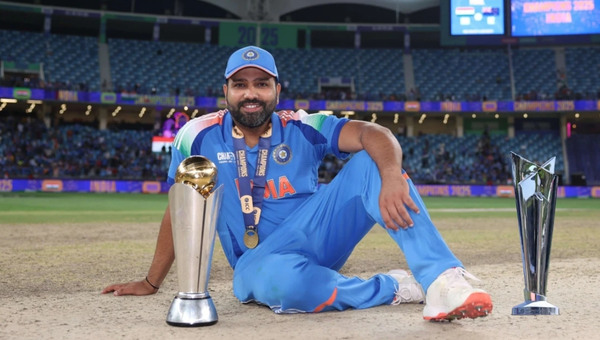
Rohit Sharma led India to victory in the 2025 ICC Champions Trophy, securing the country’s third title in the tournament. The final was played in Dubai, where India defeated New Zealand by four wickets to lift the trophy. The win held special significance because it ended India’s 12 year wait for a major ICC title in the 50 over format.
India remained unbeaten throughout the tournament. Under Rohit’s leadership, the team adopted an aggressive approach with the bat while relying heavily on spin bowling to take advantage of the slower pitches in Dubai. His tactical decisions and calm leadership were key factors in India’s consistent performances across the competition.
In the final, India successfully chased a target of 252. Rohit Sharma played a crucial innings, scoring 76 runs from 83 balls. His half century came off just 41 balls and helped India build early momentum in the chase. The strong start allowed the middle order to manage the run chase with control. Rohit’s performance earned him the Player of the Match award in the final.
Looking ahead, Rohit has expressed interest in coaching or mentoring young players once he retires, as mentioned in various interviews on Unstop.
Conclusion: A Lasting Legacy
Rohit Sharma’s career is a testament to talent, hard work, and resilience. From his early days in Borivali to becoming a cricketing icon, his journey has inspired millions. His elegant batting, record-breaking performances, and leadership qualities have made him one of the greatest cricketers of all time, as noted by Sunil Gavaskar, who compared him to Viv Richards, as per ESPNcricinfo (note: page inaccessible during research, referenced from search results).
As he continues to play for India, fans worldwide look forward to more memorable moments from the “Hitman.” His legacy is secure, and he will always be remembered as a true legend of the game.
Rohit Sharma Detailed Statistics and Records
To provide a comprehensive view, here’s a table summarizing Rohit Sharma’s career statistics across formats based on Wikipedia and NDTV Sports:
| Format | Matches | Runs | Average | Centuries | Half-Centuries | Highest Score | Strike Rate | Catches |
|---|---|---|---|---|---|---|---|---|
| Test | 67 | 4,301 | 40.57 | 12 | 18 | 212 | 57.05 | 68 |
| ODI | 273 | 11,168 | 48.76 | 32 | 58 | 264 | 92.80 | 97 |
| T20I | 159 | 4,231 | 32.05 | 5 | 32 | 121* | 140.89 | 65 |
Additionally, here’s a table of his bowling statistics showcasing his occasional off-break bowling:
| Format | Innings | Overs | Wickets | Best Figures | Average | Economy Rate |
|---|---|---|---|---|---|---|
| Test | 16 | 63.5 | 2 | 1/26 | 112.00 | 3.50 |
| ODI | 40 | 101.4 | 9 | 2/27 | 59.22 | 5.24 |
| T20I | 9 | 11.2 | 1 | 1/22 | 113.00 | 9.97 |
These tables highlight his all-round contribution to cricket, reinforcing his status as a statistical giant.